One of the most frustrating things about Ian Paisley, a man whom history ought to judge harshly for his role in creating and perpetuating a vicious cycle of violence fuelled mainly by his own sense of self-righteousness and a Bible-inspired sectarian disdain for the Roman Catholic Church and its adherents (or as my father used to put it, rather more succinctly, "that oul' bastard"), is that he was in real life very personable and likeable, and with a great sense of humour.
And while it was welcome that he became a peace maker later in life, I think Ian Jack has it right when he concludes that Ian Paisley exploited people's fears and fuelled a conflict, labelling former allies traitors and enemies devils, in large part to satisfy his own ego. Northern Ireland would never be safe until it was in the DUP's hands. Unfortunately for Northern Ireland, the manner in which he squashed other unionist leaders and ran his own party like a one-man band, has left Northern Ireland unionism led by a squad of petty political pygmies, to the detriment of all.
I have been busy on a number of fronts recently so the blog has had to take something of a back seat. If you know me though, you will have been able to guess that I was keenly observing last week's elections in Ireland, North and South, as well as in Britain and indeed Colombia (it was a fun weekend, though not so much for my partner).
An opinion piece I read today by Suzanne Breen caught by eye, since it chimed with my initial reflections after the conclusion of the local elections in Northern Ireland.
Breen's argument is that Irish nationalism in Northern Ireland is 'lacking a Jim Allister". This is partially true, but glides over the unfortunate reality that someone who is to Sinn Féin as Allister is to the DUP would be big on the armalite and low on the ballot box. However, the headline was almost certainly written by a sub and would not have been the one Breen wrote for herself.
Alex Kane has written a very good article in The Newsletter, analysing in the starkest manner I have seen yet the complete failure of Northern Ireland's unionist parties to pass the Ronseal test: they don't do what it says on the tin.
Not the Progressive Unionist Party.
And we're not just talking about the additional adjectives here; I think most people realised a long time ago that they appear to be there just for comedy value: the Democratic Unionist Party seems to be run on Leninist lines of authority; the Ulster Unionist Party have problems with geography; the Progressive Unionist Party has been regressing ever since the sad demise of David Ervine, and NI21 appears to be a reference to its membership numbers.
No, what Alex is getting at is the abject failure of the main unionist parties to put forward a positive case for the union of Northern Ireland with Great Britain. To be fair to Basil McCrea, NI21 at least can see what the problem is, though time will tell if Basil is the answer (hint: Basil is not the answer, unless the question is what goes well with tomatoes and mozzarella).
Anyway, Alex Kane's article is an interesting read, but there is one aspect of it with which I disagree. He states
There is absolutely nothing on offer, because the DUP is too concerned with keeping someone in the First Minister’s office, while the UUP is running around trying to find something – anything, it seems – to save itself from further electoral decline.
I think Alex is confusing ends with means. Here's a wee secret neither the DUP nor Sinn Féin want you to know: Martin McGuinness is never going to be First Minister of Northern Ireland. The amendments to the process for electing the FM, inserted at the behest of the DUP at St. Andrew's, mean this is never going to happen.
Unionists currently have 13 more seats in the Assembly than Nationalists. It would require Nationalists to get a net gain of 7 seats before they would be the biggest grouping. To give an idea of how difficult that would be, the last election saw Unionists come out as before, Nationalists -1 and Others (Alliance) +1. In 2007 Others gained 2, Nationalists gained 1 and Unionists lost 1. So over the past decade, Nationalists have made a net gain of zero over unionism. It's going to be a slow process, to put it mildly.
NI21
But, let's suppose for argument's sake, that Nationalists seem poised to overtake Unionists as the largest designation. Sinn Féin is easily the largest Nationalist grouping, but the SDLP have retained a sticky (see what I did there?) 10%-12% of the vote. In the name of saving the FM's name plate for a Unionist, the DUP will hoover up the UUP vote, and the UUP will willingly comply, sounding their own death knell.
For you see, the amendments from St. Andrew's mean that the First Minister is not necessarily from the largest designation: if the largest party of the largest designation is not the largest party overall, then it is the largest party overall that nominates the First Minister. Under those circumstances the DUP will be able to squeeze the unionist vote in a way that Sinn Féin will never be able to do to the SDLP.
The DUP is always going to be a bigger party in the Assembly than Sinn Féin.
In fact, it quite suits Sinn Féin's longer term agenda to be always the bridesmaid and never the bride, which is why they agreed to the procedure, though I am sure they will complain about the unfairness and a unionist veto should the circumstances ever arise.
So on this one aspect, I think Alex is wrong. Sinn Féin is never going to occupy the First Minister's office, or at least not in the next 15 or more years. The DUP knows that, and Sinn Féin know that, but they keep it secret in another of their little understandings, to allow the DUP to permanently squeeze the life out of Mike Nesbitt's party. And with his witterings today about Unionist unity, Mr. Nesbitt took one more step towards leading his party into oblivion, and one step back from making the case for the union.
And as for Sinn Féin, their job just gets that little bit easier.
There is an interesting opinion piece in today's Irish Times, discussing a Joseph Rowntree Foundation report into economic deprivation in Northern Ireland, and concluding that devolved government has made things worse, economically, for the poorest in Northern Ireland rather than better.
This could come as no surprise. While the involuntary coalition system that arose from the Good Friday Agreement might have had a chance of working if the Ulster Unionist Party and the SDLP had remained the two largest parties, it creaks under the strain of domination by two parties whose existence and electoral success depends on perpetuating the division of Northern Ireland into us and them (or as we say in Northern Ireland "usuns" and "themmuns").
Let me start by saying that the yellow in the blog post title refers to the colours of the Alliance Party of Northern Ireland, and nothing else. It might seem like a strange disclaimer with which to start a blogpost, but TWGOOFBTO in Northern Ireland (those who get out of bed to be offended) caused Ulster Unionist councillor Michael Copeland to have to issue an apology to the Alliance Party's candidate in the European elections over a tweet of his expressing similar sentiments.
One of Northern Ireland's claims to fame is that it is home to the the highest concentration in the world of TWGOOFBTO's. In fact, Michael Copeland's tweet was part of a wave of reaction from TWGOOFBTO's to comments by Anna Lo, in which she expressed her support for the idea of a united Ireland, and said that perspective stemmed from being "anti-colonial". (That being so, more than anything else, it is an indictment of the SDLP that they couldn't attract her into their ranks.)
With St. Patrick's Day coming up, there will be a lot of green shamrocks and leprechaun costumes being waved about, particularly here in the U.S. (where St. Patrick's Day was largely invented).
So, in honour of Ireland's patron saint, I was reminded of this little educational video, in case anybody happens to be planning on visiting my own little corner of Ireland to take part in the festivities.
It is a handy guide for learning to speak like a Belfast local, and in no time at all you'll blend in while you are there so you will.
I was doing some research on road traffic offences (don't ask), when I came across the first of these videos below. It just served to remind me that after all the bad press that Northern Ireland has received recently about flags, marches, intolerance, bigotry and religious censorship, everybody from Norn Irn, Catholic, Protestant, Jew, Muslim or Atheist, can all stand together and take pride in the fact that we are a world leader in horrifically graphic road safety advertisements.
Have a look if you don't believe me. (The last one is two are, by the way, particularly brutal).
All in all though, drink driving is a much more socially unacceptable behaviour in Ireland and the UK than it is in the US, so maybe it goes to show that the shock tactics in these road safety commercials work.
I listened the other day to an interview of Jamie Bryson, leading flegger shit-stirrer flag protester and putative European election candidate (that'll be a laugh). Now wee Jamie is not exactly famous for his joined-up thinking (in fact there are probably those who would be pleasantly surprised if he has managed joined-up writing), but there was a section of the interview that got me thinking.
Jamie was asked to imagine a world where he was First Minister of Northern Ireland, and asked whether he would share government with Sinn Féin. Unsurprisingly he immediately ruled it out; the interviewer (David McCann) pressed him if he would share government with parties linked to loyalist paramilitaries. Here is Jamie's response:
Personally I believe that the IRA were terrorists who set out to destroy this country. Now if the British government had allowed the UDR, RUC and the British army to take on the IRA as they wanted to…there would never have been a need for the likes of the UVF. Unfortunately the British government did not let the good men of the UDR, RUC and the British army take on the IRA, so that is why Loyalist paramilitaries came into being.
David McCann then pointed out to Jamie that the UVF was formed in 1966 (partly in response to rising tensions surrounding the 50th anniversary of the Easter Rising), three years before the Provisional IRA came into existence in response to the Official IRA's failure to protect Catholic families and homes from loyalist mobs during rioting in Belfast in the summer of 1969 (1500 Catholics were forced from their homes), and from the predations of the RUC and the 'B' Specials (Ulster Special Constabulary) - the quasi-military, and almost exclusively Protestant, reserve police force of the RUC. (I'm not trying to engage in what John Hume used to call 'whataboutery' here, just providing context for those who may not be familiar). The depressing chronicle below provides ample context.
This is a very sloppy piece of reporting by the BBC who appear to have fallen for Corey's supporters politically-charged spin on events, rather than the legal reality.
Corey was given a life sentence for murder. As this guide from the Ministry of Justice makes explains:
Released lifers:
are subject to a life licence which remains in force for the duration of their natural life;
may be recalled to prison at any time to continue serving their life sentence if it is considered necessary to protect the public
There has been all sorts of waffle put about by his sympathisers about the "lack of due process", that he never "faced a fair trial" or that he was "never questioned by the Police." All of this, while true, completely misses the point: there is no need for him to be charged with anything to have his licence revoked, nor is there any need for him to be questioned by the Police about anything.
All that is needed is a recommendation by the Parole Commissioners that he has breached the conditions of his licence or is a danger to the public, and his licence is revoked and he returns to prison to continue serving his life sentence. Corey did face trial, in 1972, and the four years he has spent in prison since 2010 are part of the sentence he received then.
Remember, these are the same Parole Commissioners who recommended his release, on licence, in 1992. They have the authority to revoke it. But a parole hearing is not a mini trial, and even with that, Mr. Corey did have a Special Advocate (a government appointed barrister with security clearance to view the confidential material which is withheld from Corey and his lawyers) appointed to represent his interests in the proceedings.
The initial decision by a single Parole Commissioner to revoke his licence was then reviewed by a panel of Commissioners, with the Special Advocate present to advance Mr. Corey's interests. As the Supreme Court judgment that denied his application for judicial review of the decision noted:
On 15 August 2011 the panel gave its decision. This comprised both a closed and an open judgment. In a detailed ruling which formed part of the open judgment, the panel stated that it was satisfied that Mr Corey had become involved in the Continuity Irish Republican Army from early 2005 and that he was in a position of leadership in that organisation from 2008 until his recall to prison. It was concluded that the appellant posed a risk of serious harm to the public at the time of his recall.
Mr. Corey's lawyers applied for judicial review of this decision, and at first instance the High Court held that Mr. Corey and his lawyers had been given insufficient details of the 'gist' of the alleged breaches of his licence that led to his being recalled to prison. This was overturned on appeal by the Court of Appeal of Northern Ireland, which held that "the material provided to the appellant and his advisers was sufficient to allow him to give effective instructions to those representing him. There was therefore no breach of article 5(4) of the [European] Convention [on Human Rights]:
“Everyone who is deprived of his liberty by arrest or detention shall be entitled to take proceedings by which the lawfulness of his detention shall be decided speedily by a court and his release ordered if the detention is not lawful.”
There were technical arguments about whether the High Court had the authority to grant Corey bail after concluding that the original decision to revoke his licence had been unfair (the Supreme Court held, rightly in my opinion, that it did not), but the bottom line is that Martin Corey was not held for four years without trial, and it was not 'like internment'.
I am slightly uncomfortable about the fact that one of the conditions attached to his renewed licence is that he doesn't talk to the media, but I am understand the rationale behind it. However, I doubt whether the blanket ban would withstand a challenge under Article 10 (Freedom of Expression) in the ECtHR.
In any case, this was a very poor piece of reporting from the BBC on this matter.
UPDATE: UTV are at it as well, describing his licence as 'bail conditions'.
Really Northern Ireland, if you are going to cover legal matters, don't use journalists who don't understand the law.
The following is a short article I wrote a couple of years ago after a research trip to the Chinese Foreign Ministry Archives in Beijing. It is based on original research. For those who may be interested I can provide the original source document archive references. Attribution requested.
UPDATE: On The Cedar Lounge Revolution Blog Brian Hanley has pointed out that the "Moscow was Rome to them" was one of his and Scott Millar's interviewees talking about Irish communists rather than the IRA. In my defence, however, I did email Brian Hanley while writing the original article for clarification on a number of points, however I never received a reply.
On
16th September 1964 a lone figure knocked at the door of the embassy of
the People’s Republic of China in Paris. The embassy had only
opened earlier that year following President de Gaulle’s decision
to break diplomatic relations with Chiang Kai-shek’s Nationalist
government and establish them with the Communist government in
Beijing. The man at the door handed over a letter of introduction to
the junior embassy staffer who had answered his knock. The letter
was from the Chief of Staff of the Irish Republican Army, Cathal
Goulding, and requested on his behalf that the letter’s deliverer
be received by Ambassador Huang Zhen.
Anyone who knows me would tell you that I like flags.
And maps.
And maps with flags.
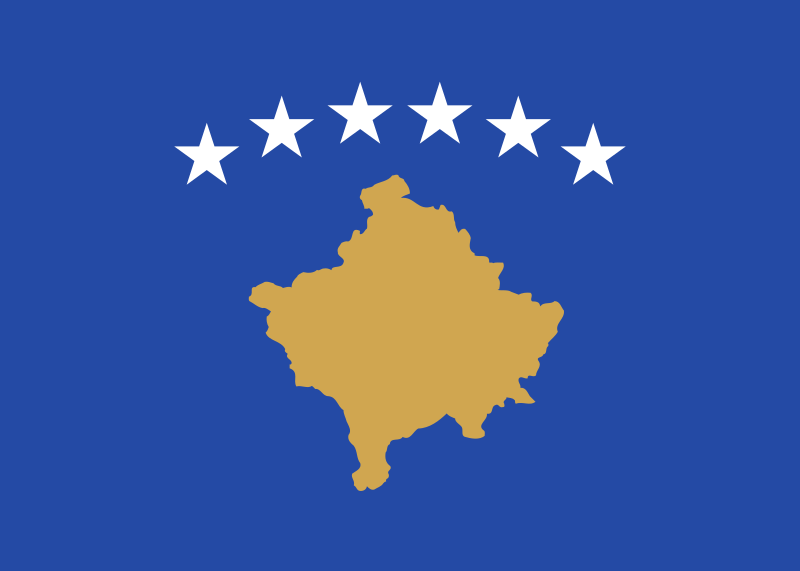
And especially flags with maps (yay for Kosovo and Cyprus!)
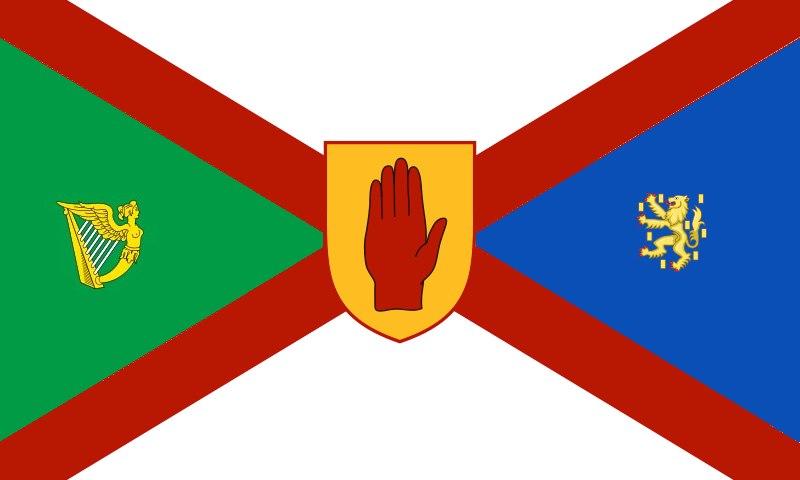
So, it will come as no surprise that I gave some thought earlier this year to the whole fleg protest, as they say back home in Norn Irn.
As has been noted by Am Ghobsmacht and others, (such as @NewNIFlag), Norn Irn hasn't actually had a flag of its own since Stormont was prorogued over 40 years ago (doesn't time fly when there's a low intensity civil war on!), despite the continued use of the 'Ulster Banner' at Orange marches and in international sporting events when Northern Ireland is playing.
The Ulster Banner: Doesn't actually represent Ulster; may not be a banner.
A common reaction to the suggestion that a way forward might be a new 'fleg' is quite often one of the following three:
1) "We already have a flag. The only flag of Northern Ireland is the Union Jack (and that other one we like to wave from time to time, even though it has no official status)." (see above)
2) "We already have a flag, it's green, white and gold."
The only green, white and gold flag I know of: Andes, a town in Colombia.
3) "Oh Christ, just what we need: ANOTHER fecking fleg."
Now, the point is of course, that reaction number 1 is for the most part correct: Northern Ireland has no other flag of its own, unlike England, Scotland and Wales, no matter what gets waved on a wet Wednesday at Windsor Park when going down to defeat by Luxembourg. Northern Ireland is unique in not having its own flag: as you can see below St. Patrick's Cross was used on the Queen's barge during the jubilee celebrations to represent Northern Ireland.
Even Cornwall has its own flag, and it's only a county. Scotland; dunno; Cornwall; Wales; Northern Ireland.
As for point number two, you have to be pretty stupid not to see the irony in waving the green, white and orange Irish tricolour while protesting against Orange parades (emphasis provided for the stupid).
So that leaves point number three, which is not an unreasonable response given all the disruption that has occurred over the past 12 months in Northern Ireland over the issue of what is currently the only legal flag for Northern Ireland.
However, surely if all this 'shared future' stuff we have been hearing from both Sinn Féin and Peter Robinson (how much he can drag the rest of the DUP along with him remains to be seen) is to mean anything, Northern Ireland can at least try and find some sort of agreed flag that everyone can unite around and be pissed off about.
Predictably this will bring about howls of protest from the sort of people who have taken to the streets with 'Ulster Independence' flags (behind Billy below) to protest the taking down of the Union Jack from Belfast City Hall save for designated days. But the fact remains that the Ulster banner was lost 40 years ago, but few really noticed (and it was only actually in place for less than 20 years).
Left to right: Will; Billy; Bill; William.
The reality is that people from a Catholic/nationalist/republican background don't feel comfortable or identify with the 'Ulster Banner', so shouting that it should be 'brought back'/'like it or lump it' isn't a viable option. It would also make it more likely that these same people would get behind the Northern Ireland football and other national teams and sportsmen and women, because as things currently stand the 'Ulster Banner' is associated with a form of unionism that, to quote David Trimble, "made a cold house for Catholics".
A shared flag for Northern Ireland also poses challenges for Sinn Féin. Although they still often like to carry on pretending that Northern Ireland doesn't exist, the fact that Martin McGuinness is deputy First Minister of Northern Ireland (and he put a lot of effort into making sure that it was deputy and not Deputy) is a bit of a give away. The fact that Sinn Féin want him or Conor Murphy or whoever to be First Minister of Northern Ireland come 2020 (or whenever, or never) is another big clue that it does. So if a shared future is to mean anything, refusing to accept a new flag for Northern Ireland would be a difficult position to hold.
And therein lies the crux of the problem for Sinn Féin, why a Northern Ireland flag and a Sinn Féin First Minister pose a big, long-term problem for them: as the North gets 'greener', with a majority from a Catholic background, and a Sinn Féin First Minister, and a booming middle class, the reasons to push for a united Ireland recede further into the background. Ulster, even after 1916 retained a stronger Redmondite/Joseph Devlin vote from its Catholics in the face of the Sinn Féin tidal wave of 1918 than elsewhere. In the Belfast Falls constituency, Devlin handily beat De Valera for the seat (though some argue it was partly out of fear of loyalist reprisals if they elected a Sinn Féiner). In the only other seat in Belfast where the Irish Parliamentary Party put up a candidate against Sinn Féin, he beat him by almost 10:1 (though the Unionist candidate, one Sir Edward Henry Carson, still won by a landslide).
'Wee Joe' Devlin: De Valera slayer.
The point is that Sinn Féin have to be concerned that nationalists will get too comfortable in the new North and decide that uniting with the 'banana republic' is not worth the hassle. For this reason, to some extent, loyalists are correct when they say that it suits Sinn Féin to have tension over Orange marches (though I don't believe that Sinn Féin initiate the tensions: they don't need to). Loyalists, however, much like Fine Gael in the Republic, never miss an opportunity to miss an opportunity. The 'in your face No Surrenderism' of the fleggers is enough to keep CNRs voting Sinn Féin, even though polls and the census tell us there is no real appetite for Irish unity, at least in the short term.
No Surrender! Votáil Sinn Féin!
Which brings us back to the new fleg. Flegger loyalism is too blinded by bigotry to see that a new flag for Northern Ireland has the potential to shore up support among Catholics for remaining within the UK, so they won't support it. Sinn Féin's longer term political goals make them worry about a new flag for Northern Ireland for the same reason. However, (though they will probably try) it would be difficult for both to put up a strong argument against a new flag if it were chosen by the people at the ballot box.
The Single Transferable Voting system that everybody in Northern Ireland is very familiar with is designed for this sort of thing. Put the Ulster Banner on the ballot with 5 others and let everybody decide on the same day as the Assembly elections in 2016.
Hopefully at the end of the process we would have a flag with 50% support. We'd probably not end up with everybody's favourite flag, but we might end up with one that people can accept, or least one that everybody hates equally.
So, in that spirit, below are a few suggestions that I put together, and a few others that I thought weren't bad. A to F are mine, the rest are suggestions from @NewNIFlag.
Comments are welcome.
I think.
-->
Vote for your top 5 at the top of the page! (Click here for full site if on mobile to see the the poll).
Hat tip to Iain Sharpe over at Eaten by Missionaries for pointing me to this article by Ruth Dudley Edwards, contemplating the differences between Irish Catholics and Ulster Protestants.
While I often find myself at odds with Dudley Edwards, this article is interesting and thought-provoking, (although I take odds with section IV, about Irish immigrants in Ireland; Ruth Dudley Edwards may have never experienced any prejudice against the Irish in her 40 years in England, but it is certainly not a typical experience. I, for example, came up against it on literally my first day here. One suspects that Edwards' anti-Catholicism, of which there is still a vain that runs through the English establishment, caused her to be welcomed into the inner-sanctum as 'one of us', despite her being Irish. And by her own admission, playing by the house-rules of her English hosts she has become, to turn the phrase describing the Anglo-Irish nobility on its head, "more English than the English.")
But anyway, back to the article. While RDE is somewhat ambiguous on the differences between 'Irish Catholics' and 'Ulster Catholics' (paraphrase: 'they are the same but different' [which is actually a reasonable enough description, if lacking somewhat in intellectual robustness]), she effectively makes a point that is often overlooked by 'outsiders' (by which I do not mean the Ulster Protestants of the title). Irish Catholics and Ulster Protestants are not the same people (not in the literal sense you understand). They are two peoples who share the same wee spot of land in the north-east Atlantic. (We shall not get into the question of the ownership of the land, which is still, in effect, the nub of the issue today. In most of rural Northern Ireland, Protestant and Catholic farmers, even if neighbours, will not sell farmland to each other).
Commentary and journalistic labels, mimicking the Ulsterfolk themselves, use 'Catholic' and 'Protestant' as short-hand for an understanding of much more profound national and cultural differences.
Outsiders to Ulster often scoff at the notion that one can tell the difference between Catholics and Protestants from appearance; they too are misguided by the religious labels. It is not always that one can tell someone in Northern Ireland's 'religion' from looking at them; in fact, I'd say it is not even often. But sometimes you can - in the same way that I see someone on the bus in London and can occasionally tell that they are Irish/Polish/Italian or whatever.
The labels 'Ulster-Scots Protestants' and 'Irish Gaelic Catholics' do not make for easy conversation, or good journalistic type. But these are essentially the labels we are talking about. And, of course, while neither of these two peoples are 'pure' - they have intermarried down generations with English, and Normans, and Vikings, and Highland Scots, this cannot override the cultural norms, not just religious and 'national' ones, that each buys into and that are separate from the other's.
As Ruth Dudley Edwards points out, Catholics have reveled in celebrating their culture, while Protestants have been reluctant to even respond to the challenge that they have none.
Part of this is, I think, that they are slightly caught on the hook of 'Britishness', which is a topic I shall return to later.




.svg/570px-Starry_Plough_flag_(1914).svg.png)



.svg/800px-Flag_of_Andes_(Antioquia).svg.png)