Supreme court to hear internet defamation dispute - The Irish Times - Thu, Apr 03, 2014
I had blogged previously on the lack of clarity that surrounds the law on defamation on the internet in Ireland (and to a lesser extent in the UK), when lawyers for Angela Kerins rather remarkably threatened Irishcentral.com for speculating on what Ms. Kerins' salary is (information that was subsequently made public just a few weeks later).
According to today's Irish Times we may get some clarity on some of the issues, though given the backlog of cases awaiting hearing before the Supreme Court quite when that might be is still unclear.
The case is an appeal from the decision in McKeogh v Facebook & Ors. in which a student was incorrectly identified in a YouTube video as having failed to pay a taxi fare, and his name was bandied about on Facebook, YouTube and a number of different forums, in the process of which he was "seriously and nastily defamed" in the words of the trial judge.
(If you are getting a weird message below, ignore it and click where it says 'here' to read the judgment).
I mentioned in the original post that I was not aware of any Irish decisions that litigated the key issues, such as whether an ISP or web host is a publisher, and the extent to which Article 14 of the E-Commerce Directive provides them protection. This case would appear to address these issues, but the appeal is against the interim injunctions that were put in place over two years ago (Irish 'justice' moves embarrassingly slowly), a full hearing of the issues being stayed until the appeals against the injunctive relief are heard.
Hopefully the Supreme Court will take the opportunity to lay down guidelines which can be applied if and when the substantive claim gets heard.
Nonetheless, any further clarification of the responsibilities and liabilities of web hosts and bloggers with regard to potentially defamatory material is to be welcomed.
The sooner this case gets a hearing the better.
Showing posts with label Ireland. Show all posts
Showing posts with label Ireland. Show all posts
Thursday, 3 April 2014


Sunday, 16 March 2014


Friday, 14 March 2014
You want to speak Belfast Northern Irish so you do?
With St. Patrick's Day coming up, there will be a lot of green shamrocks and leprechaun costumes being waved about, particularly here in the U.S. (where St. Patrick's Day was largely invented).
So, in honour of Ireland's patron saint, I was reminded of this little educational video, in case anybody happens to be planning on visiting my own little corner of Ireland to take part in the festivities.
It is a handy guide for learning to speak like a Belfast local, and in no time at all you'll blend in while you are there so you will.
Friday, 21 February 2014
Chilling effect on the internet?
This story originally caught my attention when I saw a tweet from Niall O'Dowd as I boarded a plane for a week's holiday in the U.S. Virgin Islands (that's not relevant to this post, I just like rubbing it in).
@NiallODowd Have you taken down the John Spain article?
— Chris Connolly (@Cripipper) February 15, 2014
O'Dowd's tweet linked to a story in Irish Central (his U.S.-based news website), outlining the circumstances under which a story by John Spain relating to the salary of the Chief Executive of the Irish charity REHAB had been taken down after legal threats from Ms. Kerins' solicitors. I have made reference to Angela Kerins in a previous post here (REHAB this week released her salary, just FYI: €240,000. No, I did not accidentally slip on an extra digit.)
 O'Dowd stated that the site's host, Clickability, had been warned to take down the story, but didn't actually say that it had been taken down (which would have been, from a legal perspective, a very surprising decision on their part.) After having read the story I was surprised to notice that the story O'Dowd was referring to was no longer on the site, particularly given O'Dowd's statement in the article "Thank God for the First Amendment" and so tweeted to him asking about it. I received no reply, so was therefore interested to see this article in Tuesday's Irish Times.
Monday, 17 February 2014
Quis custodiet ipsos custodes?
This classical Latin question of 2,000 years ago has no greater relevance than to Ireland today. The national police force, An Garda Síochána (the Guardians of the Peace), is commonly referred to in English as 'the Guards'. After a series of policing scandals, in 2005 an Ombudsman was established, the Garda Síochána Ombudsman Commission (GSOC), to provide an answer to Juvenal's question of who will guard the guards.
The Commission was partly modelled on the equivalent office in Northern Ireland, but with fewer and blunter teeth. Its relationship with the Gardaí has been, it has to be said, a tense one (€) over the years, characterised by suspicion (€) and misunderstanding. GSOC has made some mistakes along the way that caused little love to be lost (€) between the two organisations. This sits atop the natural loathing that any police organisation has for a body designed to oversee it. It is just the nature of the beast.
Nonetheless, from a human rights perspective, to have a permanent police ombudsman is something of which Ireland should be proud, and places it in a very small number of jurisdictions in the world to have such a set-up.
It is natural, therefore, that Irish people should be concerned by reports in the press, first broken by The Sunday Times, that GSOC became concerned that the security of its offices had been breached. They employed a British security company to sweep their offices, in the course of which they discovered three 'anomalies'. Gavan Reilly outlines what they were in an excellent blogpost, that gets to the heart of a lot of this puzzling issue, or Sunday Times subscribers can recap on the detail from John Mooney here, a screengrab from which I have included below (click to zoom). It should also be noted that Ireland should be grateful to the 'British' Sunday Times (as members of the Government have repeatedly referred to it) and John Mooney in particular, for pursuing this issue when other Irish media outlets sucked up the Government spin and spat it out again to its readers and viewers.

There are a lot of questions remaining, but to distil what they are, I want to go back through the chronology of what happened, and add my own thoughts and speculation.
Wednesday, 12 February 2014
Gay, gayer, gayist?
From the comfort of my armchair in
Washington and no longer inhabiting the ivory towers of academia, I
had no idea what a shitstorm of debate, both in Ireland and in the
social sciences, I was wading into with my blog post commenting on
'Pantigate' and use of the word homophobia. A slightly edited version of it appeared as a column in last Friday's Irish Times.
It certainly provoked mixed responses:
@Cripipper
@IrishTimes
One of the finest contributions yet to this whole debate. Brilliantly
written and argued
— Mark Paul (@MarkPaulTimes) February
7, 2014
 |
| (my mum on the Irish Times comment section, using the pseudonym 'Labhaoise O'Donovan') |
I
don't think I persuaded many by my argument, as each side in the
debate is fairly entrenched, but I still feel that it is the one that
would have been accepted by the High Court (which was the legal
advice that RTÉ also received). In some respects by paying out, RTÉ
has saved the the gay rights activist community from a loss in Court
that would have affirmed that to be against gay marriage is not to be
homophobic per se.
But
in the past week, the debate has further broadened and has led me to
ask, why do we even use the term 'homophobia' at all?
Tuesday, 4 February 2014
Things Culchies Love
Yesterday's post of Feilim McHugh's brilliant da, reminded me of a list from many years ago of 'Things Culchies Love'. If you're not Irish, you probably don't know what a culchie is: it's someone from the country; someone who engages in agricultural pursuits. I think it's pretty fair to say that Feilim's oul fella is a culchie (the giveaway was the hat).
So, in honour of Feilim's da, here is, resurrected from the vaults of the interwebs, a list of things culchies love.

So, in honour of Feilim's da, here is, resurrected from the vaults of the interwebs, a list of things culchies love.
Monday, 3 February 2014
The most Irish thing you will ever see in your life
No really, this is the funniest thing I have seen in a long time. It is more Irish than Bono and Sinéad O'Connor dancing The Waves of Tory down O'Connell Street in giant shamrock costumes while knocking a sliotar back and forth between them and skulling a pint with a wee chaser. It is, pure brilliance.
WARNING: There is some very, erm, authentic language used here.
NSFW, unless you are in Ireland.
Or Australia.
And don't work in a convent.
Unless all the nuns are Irish.
If the embedded video isn't working, click on this link.
WARNING: There is some very, erm, authentic language used here.
NSFW, unless you are in Ireland.
Or Australia.
And don't work in a convent.
Unless all the nuns are Irish.
If the embedded video isn't working, click on this link.
Is that a Neknominate bandwagon I hear passing?
Ireland's Minister for Communications deserves to be moved to Minister for Transport in any Cabinet reshuffle, for he rarely misses an opportunity to jump aboard a passing bandwagon.
UPDATE: among those also clambering on, in the wake of Pat Rabbitte's statement, appear to be most of the British press: see here and here and here for examples.
Today's Irish Times reports that the Minister had called for a ban on the so-called internet drinking game 'Neknominate', whereby you film yourself necking a drink, post the video to Facebook, and then nominate someone else to do the same thing.
It all sound harmless enough, right? Well, it probably would be, in a normal country with a normal relationship with alcohol. However, Irish and British people do not have a normal relationship with alcohol, so instead of sun-drenched Australians cross-dressing in bikinis and downing a bottle of Victoria Lager, or attempting to down a beer while water-skiing, we get people downing pints of vodka and biting the head off a dead chicken, downing pints of whisky, and downing beers and then getting into a flooded river.
Sadly, these last two 'Neknominations' appear to have led to the deaths of at least one, and possible two (the circumstances surrounding the whiskey-drinking 'Neknomination' are in dispute) young men in Ireland, which has prompted the Minister to lead the charge of "something must be done!"
UPDATE: among those also clambering on, in the wake of Pat Rabbitte's statement, appear to be most of the British press: see here and here and here for examples.
 |
| Minister Rabbitte and his wife. |
It all sound harmless enough, right? Well, it probably would be, in a normal country with a normal relationship with alcohol. However, Irish and British people do not have a normal relationship with alcohol, so instead of sun-drenched Australians cross-dressing in bikinis and downing a bottle of Victoria Lager, or attempting to down a beer while water-skiing, we get people downing pints of vodka and biting the head off a dead chicken, downing pints of whisky, and downing beers and then getting into a flooded river.
Sadly, these last two 'Neknominations' appear to have led to the deaths of at least one, and possible two (the circumstances surrounding the whiskey-drinking 'Neknomination' are in dispute) young men in Ireland, which has prompted the Minister to lead the charge of "something must be done!"
Saturday, 25 January 2014
And the Oul' Collecting Tin Went Jingle-Jangle...
It feels like I have been bashing Ireland a lot these past few days, but then that's like blaming someone playing Whack-a-mole for battering the little blighters when they appear.
As a further illustration of the endemic problems Ireland has, I now have to turn to the sorry tale of the charitable sector and the inflated pay of some of its senior executives.

So one of two things happened:
 |
| The RTÉ News. |
As a further illustration of the endemic problems Ireland has, I now have to turn to the sorry tale of the charitable sector and the inflated pay of some of its senior executives.
Ireland is rather odd in that much of what is the function of the State in most other countries (the provision of education, healthcare and other social services) was contracted out to the 'charitable sector' (primarily the Catholic Church) by a very poor newborn national government, and enthusiastically embraced by churches, holy orders and charities, for whom the provision of such services guaranteed a line of government funding, and gave them a degree of control over the recipients of the services (think again of the Catholic Church and education). The result is the sad tale of the like of the Magdalene laundries and mental asylums, where the Irish State paid private institutions to make problems disappear.
And although charitable fundraising to supplement the budgets of hospitals and schools is pretty common in the UK and the US, it is (I think) even more prevalent in Ireland, where many of the charities and institutions could not function at all, despite funds from central government, without the committed and dedicated work of its supporters and volunteers, running raffles, selling teddies and taking street donations, all to plug a gap in service provision that the inadequacy of funds from direct taxation has created. Many of these charities, such as the Central Remedial Clinic do sterling work, and provide support and relief to many of the most disadvantaged, unfortunate or challenged in Irish society.
I cannot begin to understand then the disappointment and sense of betrayal felt by people such as Tom Clonan, when they discovered that the Board of the CRC, like that of St. Vincent's hospital in Dublin, had been making 'top-up' payments to the salaries of senior executives from private sources, including the charitable funds raised by the charity's supporters.
Essentially, when Ireland fell into economic crisis, pay-caps were introduced across much of the public sector to reflect the strained circumstances the Exchequer found itself in, and to dampen public anger towards salaries that were barely justifiable during the boom times let alone in a country that was bankrupt. For charitable bodies like the CRC and St. Vincent's, whose senior executives receive salaries that are mostly funded from the public purse, but also partly-funded from private sources, the boards of these organisations decided (apparently having signed employment contracts that made no allowance for pay reductions in times of reduced funding) to adhere to their contractual obligations and top-up their CEO's pay-packets from their private funds.
 |
| Private funds (NB: Children In Need is in no way implicated) |
So one of two things happened:
Friday, 24 January 2014
Move along, there’s nothing to see here, says Garda Commissioner
Move along, there’s nothing to see here, says Garda Commissioner - Crime & Law News from Ireland & Abroad | The Irish Times - Fri, Jan 24, 2014
I thought I was finished blogging for the day, when I came across this blistering piece of form from Miriam Lord in The Irish Times (above).
In a post the other day I wrote about Ireland's problems being so endemic and culturally-embedded that it would take decades for the country to put its house in order. I felt at the time that it was a bit of an empty allegation to leave hanging, but at the same time the subject is just so vast and so frustrating that I genuinely wouldn't know where to begin. Also, it was getting late and Camilo was getting annoyed that I was still up.
But here you have just a day or two later a prize, Grade-A, first class, award-winning, prime example of the sort of problems that I referred to.
Can you imagine the Chief Constable of an English police force or Police Scotland appearing before a House of Commons or Scottish Parliament Select Committee and telling the parliamentarians they had no business inquiring into the behind-the-doors workings of his force, and following that up with a threat against future (or "so called", in the words of the Garda Commissioner) whistle-blowers?
I thought I was finished blogging for the day, when I came across this blistering piece of form from Miriam Lord in The Irish Times (above).
In a post the other day I wrote about Ireland's problems being so endemic and culturally-embedded that it would take decades for the country to put its house in order. I felt at the time that it was a bit of an empty allegation to leave hanging, but at the same time the subject is just so vast and so frustrating that I genuinely wouldn't know where to begin. Also, it was getting late and Camilo was getting annoyed that I was still up.
But here you have just a day or two later a prize, Grade-A, first class, award-winning, prime example of the sort of problems that I referred to.
Can you imagine the Chief Constable of an English police force or Police Scotland appearing before a House of Commons or Scottish Parliament Select Committee and telling the parliamentarians they had no business inquiring into the behind-the-doors workings of his force, and following that up with a threat against future (or "so called", in the words of the Garda Commissioner) whistle-blowers?
Ze Germans Aren't ze Bad Guys
Germany’s central bank backed move to burn bondholders - Irish Economy News & Headlines | The Irish Times - Fri, Jan 24, 2014
A popular narrative has existed in many of the eurozone countries hardest-hit by the Great Recession that says the suffering of the people of [insert choice of Ireland/Greece/Spain/Cyprus/Portugal/Italy] has been orchestrated to save ze Germans from losing their geld. It's not a terribly convincing explanation and in some countries, most notably Greece, has been part and parcel of a fairly disgusting racist campaign against both those who are perceived as having money, and against ethnic and racial minorities (in times of worse economic crisis in 1930s Germany, these were one and the same).
In Ireland there was much understandable domestic anger at slack and irresponsible lending practices by Irish banks. While to a certain degree this allows Irish borrowers to let themselves off the hook for irresponsible borrowing, it is hard not to sympathise with your average couple keen to get on the housing ladder and who took whatever was offered to them by the bank. (Sympathy wanes somewhat, when it comes to commercial borrowers and those who borrowed to buy apartments in Spain, Estonia and Bulgaria).
So, the story goes, where you have irresponsible borrowers you also have irresponsible lenders, who really should know better and are really the villains of the piece. And now that the Irish taxpayer has had to shoulder the multi-billion euro burden of the mistakes of Ireland's banks, who was so irresponsible to lend so much money to Ireland's banks that they had to shove it down the throats of Ireland's borrowers, whether it was prudent for the borrower to take out such large loans or not?
And the answer of course is: Ze Germans!
A popular narrative has existed in many of the eurozone countries hardest-hit by the Great Recession that says the suffering of the people of [insert choice of Ireland/Greece/Spain/Cyprus/Portugal/Italy] has been orchestrated to save ze Germans from losing their geld. It's not a terribly convincing explanation and in some countries, most notably Greece, has been part and parcel of a fairly disgusting racist campaign against both those who are perceived as having money, and against ethnic and racial minorities (in times of worse economic crisis in 1930s Germany, these were one and the same).
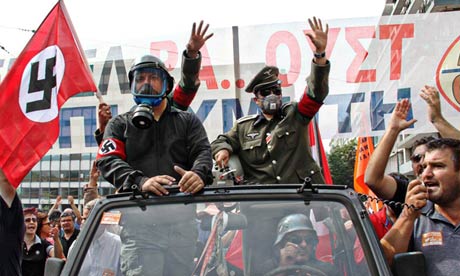 |
| Tory MPs on their way to a stag do in Athens. Photograph: Action Press/Rex Features |
So, the story goes, where you have irresponsible borrowers you also have irresponsible lenders, who really should know better and are really the villains of the piece. And now that the Irish taxpayer has had to shoulder the multi-billion euro burden of the mistakes of Ireland's banks, who was so irresponsible to lend so much money to Ireland's banks that they had to shove it down the throats of Ireland's borrowers, whether it was prudent for the borrower to take out such large loans or not?
And the answer of course is: Ze Germans!
Tuesday, 21 January 2014
An Irish Financial Sanity Check
The Alphaville blog on the Financial Times makes a very important point:

This follows a report in today's Irish Times, that Ireland is still the 5th most expensive country in the EU, with prices 15% above the European average. Ireland is the 11th wealthiest country in the EU (based on GNI, a more reflective index than GDP in Ireland's case), at 5% above the European average.
The country's problems are so endemic, so culturally embedded and its politics and constitutional system so stunted, that it is going to take decades, if ever, for Ireland to fully put its house in order.
Ireland may have left the bailout, but it still has a heck of a long way to go. I wish the country well, but sure as hell am glad I am not there any more.
"until your local stock market can adequately price one of your biggest banks, your local finance sector still has some way to go."It draws attention to the massively inflated valuation of AIB on the Irish Stock Exchange.
The country's problems are so endemic, so culturally embedded and its politics and constitutional system so stunted, that it is going to take decades, if ever, for Ireland to fully put its house in order.
Ireland may have left the bailout, but it still has a heck of a long way to go. I wish the country well, but sure as hell am glad I am not there any more.
Friday, 25 October 2013
Mao and The IRA's Chinese Takeaway
 |
| Flag of the People's Republic of China (PRC) |
The following is a short article I wrote a couple of years ago after a research trip to the Chinese Foreign Ministry Archives in Beijing. It is based on original research. For those who may be interested I can provide the original source document archive references. Attribution requested.
UPDATE: On The Cedar Lounge Revolution Blog Brian Hanley has pointed out that the "Moscow was Rome to them" was one of his and Scott Millar's interviewees talking about Irish communists rather than the IRA. In my defence, however, I did email Brian Hanley while writing the original article for clarification on a number of points, however I never received a reply.
.svg/570px-Starry_Plough_flag_(1914).svg.png) |
| The Starry Plough |
On
16th September 1964 a lone figure knocked at the door of the embassy of
the People’s Republic of China in Paris. The embassy had only
opened earlier that year following President de Gaulle’s decision
to break diplomatic relations with Chiang Kai-shek’s Nationalist
government and establish them with the Communist government in
Beijing. The man at the door handed over a letter of introduction to
the junior embassy staffer who had answered his knock. The letter
was from the Chief of Staff of the Irish Republican Army, Cathal
Goulding, and requested on his behalf that the letter’s deliverer
be received by Ambassador Huang Zhen.
Subscribe to:
Posts (Atom)