Move along, there’s nothing to see here, says Garda Commissioner - Crime & Law News from Ireland & Abroad | The Irish Times - Fri, Jan 24, 2014
I thought I was finished blogging for the day, when I came across this blistering piece of form from Miriam Lord in The Irish Times (above).
In a post the other day I wrote about Ireland's problems being so endemic and culturally-embedded that it would take decades for the country to put its house in order. I felt at the time that it was a bit of an empty allegation to leave hanging, but at the same time the subject is just so vast and so frustrating that I genuinely wouldn't know where to begin. Also, it was getting late and Camilo was getting annoyed that I was still up.
But here you have just a day or two later a prize, Grade-A, first class, award-winning, prime example of the sort of problems that I referred to.
Can you imagine the Chief Constable of an English police force or Police Scotland appearing before a House of Commons or Scottish Parliament Select Committee and telling the parliamentarians they had no business inquiring into the behind-the-doors workings of his force, and following that up with a threat against future (or "so called", in the words of the Garda Commissioner) whistle-blowers?
Friday, 24 January 2014


Ze Germans Aren't ze Bad Guys
Germany’s central bank backed move to burn bondholders - Irish Economy News & Headlines | The Irish Times - Fri, Jan 24, 2014
A popular narrative has existed in many of the eurozone countries hardest-hit by the Great Recession that says the suffering of the people of [insert choice of Ireland/Greece/Spain/Cyprus/Portugal/Italy] has been orchestrated to save ze Germans from losing their geld. It's not a terribly convincing explanation and in some countries, most notably Greece, has been part and parcel of a fairly disgusting racist campaign against both those who are perceived as having money, and against ethnic and racial minorities (in times of worse economic crisis in 1930s Germany, these were one and the same).
In Ireland there was much understandable domestic anger at slack and irresponsible lending practices by Irish banks. While to a certain degree this allows Irish borrowers to let themselves off the hook for irresponsible borrowing, it is hard not to sympathise with your average couple keen to get on the housing ladder and who took whatever was offered to them by the bank. (Sympathy wanes somewhat, when it comes to commercial borrowers and those who borrowed to buy apartments in Spain, Estonia and Bulgaria).
So, the story goes, where you have irresponsible borrowers you also have irresponsible lenders, who really should know better and are really the villains of the piece. And now that the Irish taxpayer has had to shoulder the multi-billion euro burden of the mistakes of Ireland's banks, who was so irresponsible to lend so much money to Ireland's banks that they had to shove it down the throats of Ireland's borrowers, whether it was prudent for the borrower to take out such large loans or not?
And the answer of course is: Ze Germans!
A popular narrative has existed in many of the eurozone countries hardest-hit by the Great Recession that says the suffering of the people of [insert choice of Ireland/Greece/Spain/Cyprus/Portugal/Italy] has been orchestrated to save ze Germans from losing their geld. It's not a terribly convincing explanation and in some countries, most notably Greece, has been part and parcel of a fairly disgusting racist campaign against both those who are perceived as having money, and against ethnic and racial minorities (in times of worse economic crisis in 1930s Germany, these were one and the same).
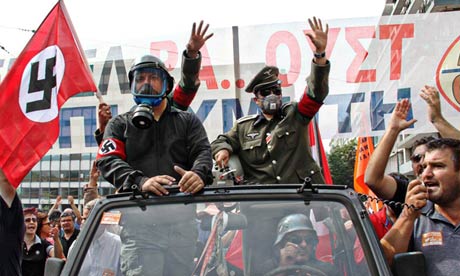 |
| Tory MPs on their way to a stag do in Athens. Photograph: Action Press/Rex Features |
So, the story goes, where you have irresponsible borrowers you also have irresponsible lenders, who really should know better and are really the villains of the piece. And now that the Irish taxpayer has had to shoulder the multi-billion euro burden of the mistakes of Ireland's banks, who was so irresponsible to lend so much money to Ireland's banks that they had to shove it down the throats of Ireland's borrowers, whether it was prudent for the borrower to take out such large loans or not?
And the answer of course is: Ze Germans!
The Long Quest for an International Order with Chinese Characteristics
The Long Quest for an International Order with Chinese Characteristics: A Cultural Perspective on Modern China's Foreign Policies Connolly 2013 Pacific Focus Wiley Online Library
I hadn't realised that an article I co-wrote with a former colleague of mine, Joern-Carstern Gottwald, has been published in Pacific Focus. I think it is currently free to read, so click on the link above if it is your sort of thing.
I hadn't realised that an article I co-wrote with a former colleague of mine, Joern-Carstern Gottwald, has been published in Pacific Focus. I think it is currently free to read, so click on the link above if it is your sort of thing.
Thursday, 23 January 2014
The IRA and Mao's China: in the press
My piece on the IRA's, in the guise of Seamus Costello, approach to the Mao Zedong's China in 1964 was picked up by Clifford Coonan of The Irish Times, with whom I had an email exchange to expand on some issues before he wrote the piece.
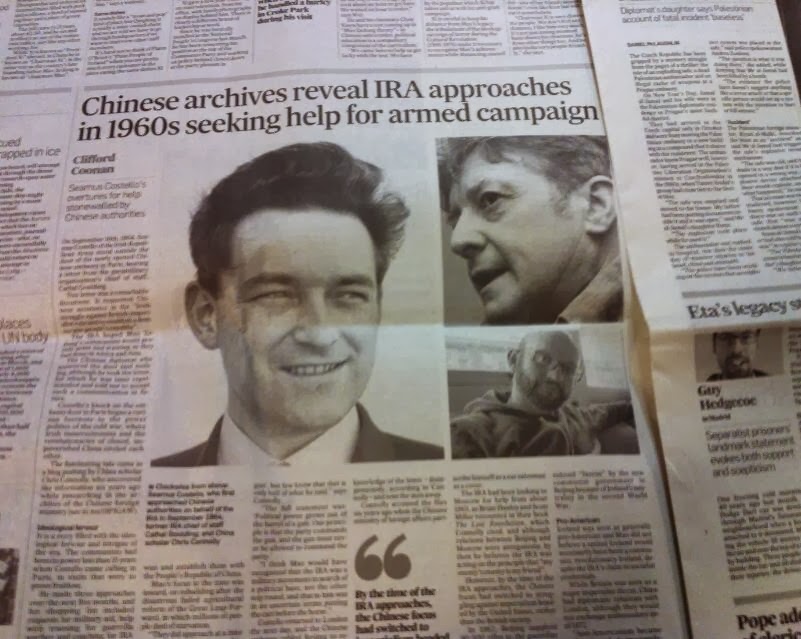
I've just been made aware, however, that The Times also picked up (£) on the story, in what is a pretty garbled and incoherent account, complete with totally made up quotes from me! (Google has informed me that HuffingtonPost.it ran with The Times story as well.
I've just been made aware, however, that The Times also picked up (£) on the story, in what is a pretty garbled and incoherent account, complete with totally made up quotes from me! (Google has informed me that HuffingtonPost.it ran with The Times story as well.
Tuesday, 21 January 2014
An Irish Financial Sanity Check
The Alphaville blog on the Financial Times makes a very important point:

This follows a report in today's Irish Times, that Ireland is still the 5th most expensive country in the EU, with prices 15% above the European average. Ireland is the 11th wealthiest country in the EU (based on GNI, a more reflective index than GDP in Ireland's case), at 5% above the European average.
The country's problems are so endemic, so culturally embedded and its politics and constitutional system so stunted, that it is going to take decades, if ever, for Ireland to fully put its house in order.
Ireland may have left the bailout, but it still has a heck of a long way to go. I wish the country well, but sure as hell am glad I am not there any more.
"until your local stock market can adequately price one of your biggest banks, your local finance sector still has some way to go."It draws attention to the massively inflated valuation of AIB on the Irish Stock Exchange.
The country's problems are so endemic, so culturally embedded and its politics and constitutional system so stunted, that it is going to take decades, if ever, for Ireland to fully put its house in order.
Ireland may have left the bailout, but it still has a heck of a long way to go. I wish the country well, but sure as hell am glad I am not there any more.
Support Our Droops

RTÉ are cheerfully reporting that the British Tommies have been pilfering supplies to fill their johnnies.
I couldn't help but think of this Second World War propaganda poster.

'Westerners are so convinced China is a dystopian hellscape they’ll share anything that confirms it'
That's the headline in a piece from Quartz.com, which is pretty much the same theme that I wrote about a few months ago. This time it's the infamous 'video sunset', allegedly set up for the benefit of Beijing's residents who can no longer see the real thing due to the thick pollution. This is, of course, a load of cobblers.
The photo is actually from a tourism advert for Shandong province, and is part of a 10-second long piece playing on a loop. But, hey, if I were the photographer who took such a great shot, I would be tempted to put something out there that is going to get it published in many of the world's major news outlets (not that I am saying he did that, you understand, no, no, no...)

The photo is actually from a tourism advert for Shandong province, and is part of a 10-second long piece playing on a loop. But, hey, if I were the photographer who took such a great shot, I would be tempted to put something out there that is going to get it published in many of the world's major news outlets (not that I am saying he did that, you understand, no, no, no...)
Monday, 20 January 2014
Oh East is East, and West is West
I listened the other day to an interview of Jamie Bryson, leading
Jamie was asked to imagine a world where he was First Minister of Northern Ireland, and asked whether he would share government with Sinn Féin. Unsurprisingly he immediately ruled it out; the interviewer (David McCann) pressed him if he would share government with parties linked to loyalist paramilitaries. Here is Jamie's response:
Personally I believe that the IRA were terrorists who set out to destroy this country. Now if the British government had allowed the UDR, RUC and the British army to take on the IRA as they wanted to…there would never have been a need for the likes of the UVF. Unfortunately the British government did not let the good men of the UDR, RUC and the British army take on the IRA, so that is why Loyalist paramilitaries came into being.David McCann then pointed out to Jamie that the UVF was formed in 1966 (partly in response to rising tensions surrounding the 50th anniversary of the Easter Rising), three years before the Provisional IRA came into existence in response to the Official IRA's failure to protect Catholic families and homes from loyalist mobs during rioting in Belfast in the summer of 1969 (1500 Catholics were forced from their homes), and from the predations of the RUC and the 'B' Specials (Ulster Special Constabulary) - the quasi-military, and almost exclusively Protestant, reserve police force of the RUC. (I'm not trying to engage in what John Hume used to call 'whataboutery' here, just providing context for those who may not be familiar). The depressing chronicle below provides ample context.
Friday, 17 January 2014
Martin Corey held for four years in prison without trial?
So says a BBC news report on his release.

This is a very sloppy piece of reporting by the BBC who appear to have fallen for Corey's supporters politically-charged spin on events, rather than the legal reality.
Corey was given a life sentence for murder. As this guide from the Ministry of Justice makes explains:
Released lifers:
- are subject to a life licence which remains in force for the duration of their natural life;
- may be recalled to prison at any time to continue serving their life sentence if it is considered necessary to protect the public
There has been all sorts of waffle put about by his sympathisers about the "lack of due process", that he never "faced a fair trial" or that he was "never questioned by the Police." All of this, while true, completely misses the point: there is no need for him to be charged with anything to have his licence revoked, nor is there any need for him to be questioned by the Police about anything.
All that is needed is a recommendation by the Parole Commissioners that he has breached the conditions of his licence or is a danger to the public, and his licence is revoked and he returns to prison to continue serving his life sentence. Corey did face trial, in 1972, and the four years he has spent in prison since 2010 are part of the sentence he received then.
Remember, these are the same Parole Commissioners who recommended his release, on licence, in 1992. They have the authority to revoke it. But a parole hearing is not a mini trial, and even with that, Mr. Corey did have a Special Advocate (a government appointed barrister with security clearance to view the confidential material which is withheld from Corey and his lawyers) appointed to represent his interests in the proceedings.
The initial decision by a single Parole Commissioner to revoke his licence was then reviewed by a panel of Commissioners, with the Special Advocate present to advance Mr. Corey's interests. As the Supreme Court judgment that denied his application for judicial review of the decision noted:
Mr. Corey's lawyers applied for judicial review of this decision, and at first instance the High Court held that Mr. Corey and his lawyers had been given insufficient details of the 'gist' of the alleged breaches of his licence that led to his being recalled to prison. This was overturned on appeal by the Court of Appeal of Northern Ireland, which held that "the material provided to the appellant and his advisers was sufficient to allow him to give effective instructions to those representing him. There was therefore no breach of article 5(4) of the [European] Convention [on Human Rights]:On 15 August 2011 the panel gave its decision. This comprised both a closed and an open judgment. In a detailed ruling which formed part of the open judgment, the panel stated that it was satisfied that Mr Corey had become involved in the Continuity Irish Republican Army from early 2005 and that he was in a position of leadership in that organisation from 2008 until his recall to prison. It was concluded that the appellant posed a risk of serious harm to the public at the time of his recall.
There were technical arguments about whether the High Court had the authority to grant Corey bail after concluding that the original decision to revoke his licence had been unfair (the Supreme Court held, rightly in my opinion, that it did not), but the bottom line is that Martin Corey was not held for four years without trial, and it was not 'like internment'.“Everyone who is deprived of his liberty by arrest or detention shall be entitled to take proceedings by which the lawfulness of his detention shall be decided speedily by a court and his release ordered if the detention is not lawful.”
I am slightly uncomfortable about the fact that one of the conditions attached to his renewed licence is that he doesn't talk to the media, but I am understand the rationale behind it. However, I doubt whether the blanket ban would withstand a challenge under Article 10 (Freedom of Expression) in the ECtHR.
In any case, this was a very poor piece of reporting from the BBC on this matter.
UPDATE: UTV are at it as well, describing his licence as 'bail conditions'.
Really Northern Ireland, if you are going to cover legal matters, don't use journalists who don't understand the law.
Oh, and

Thursday, 9 January 2014
Law and Lawyers: Mark Duggan Inquest by Obiter J
A good post from Obiter J's blog:
Law and Lawyers: Mark Duggan Inquest: Mark Duggan 1981-2011 The evening of 4th August 2011. At Ferry Lane (Tottenham, London), the Police intercepted and stopped a taxi (or ...
Law and Lawyers: Mark Duggan Inquest: Mark Duggan 1981-2011 The evening of 4th August 2011. At Ferry Lane (Tottenham, London), the Police intercepted and stopped a taxi (or ...
Subscribe to:
Posts (Atom)